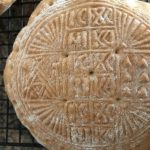
Orthodox Holy Bread
A prosphoron or prosphora is a small loaf of leavened bread used in Orthodox Christian liturgies.
Servings: 1 loaf
Equipment
- Prosphora Seal
- Baking Sheet
- Parchment Paper (recommended)
Ingredients
- 2 cups (300g) flour
- ¾ cup (180mL) water
- 1 tsp (3.5g) yeast
- ½ tsp (2.5g) salt
Instructions
- Add yeast to lukewarm water (100F or 38C) and stir to hydrate the granules. Set aside.
- In a large bowl, mix together flour and salt. Using the handle of a spoon, stir in the yeast mixture until a shaggy dough forms. Turn out onto a clean work surface.
- Knead the dough for 8 - 12 minutes by hand or until the dough stretches easily without tearing. (A stand mixer may be used. Knead for 10 minutes with a dough hook on the appropriate speed for your machine.)
- Cover and allow dough to rest for 1 -2 hours or until double in size.
- Move the oven rack to the middle and preheat oven 400F (200F.)
- Lightly flour the work surface. Turn out the dough, flattening it down. Shape the dough into a flat circle slightly larger than the seal.
- Carefully place the shaped dough onto a baking sheet lined with parchment paper. Rest the dough 5 - 10 minutes to let the gluten relax. Failure to do so will often result in a seal that wrinkles while baking. Lightly flour the surface of your dough.
- Flour the prosphora seal and tap out the excess. Press the seal down firmly while saying the Lord's Prayer. Lift the seal gently and using a skewer, firmly poke 33 holes around the formed seal to allow for ventilation.
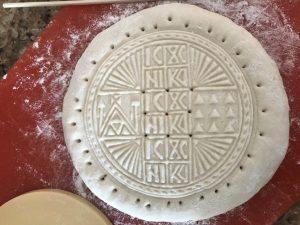
- Bake 35-45 minutes or until golden brown. The bread will sound hollow when tapped on the bottom. Center of bread should read 212F (100C.)
- Let cool completely on a wire rack before wrapping and taking to the priest. May also be frozen for future use.
Notes
- If the seal is stuck to the bread, gently pry one side loose with a butter knife. If seal is ruined, you can reshape the dough and repress.
- A second rise is intentionally omitted in order for the seal to maintain the best possible appearance.
- Traditions, beliefs and viewpoints can vary widely among the different branches and within congregations. Before poking holes in the bread, ask your priest if this is permissible or even desirable. We were taught to do this decades ago as the seal in particular was getting air trapped under and it prevented the Priest from being able to cut the bread properly for service.
- For a lighter crust, bake at 350F (180C) for 50-60 minutes or until golden brown and bottom sounds hollow when tapped.
- Do not add sugar, rose water, oil or other additives to the bread or baking sheet. They can damage the delicate metals of the diskos and chalice over time.
- Do not grease the baking sheet or use wax paper if you don't have parchment paper. Use either a baking sheet with a nonstick surface or a silicone mat.
- Some churches make two loaves, one placed one on top of another and baked together to form a single loaf. This double-loaf represents the two natures of Christ: human and divine. You will need to double the recipe above if you are making this style and follow the directions according to your church.
- This recipe is for a single loaf only. When learning how to make Holy Bread, it is always wise to ask a fellow member for guidance as traditions and techniques will vary across the branches of Orthodoxy.
Nutrition
Serving: 1 loaf | Calories: 800 kcal | Carbohydrates: 176 g | Protein: 24 g